Understanding What Users Want From AI Agents & Co-pilots
Company
Hootsuite
Role
Junior UX Researcher
Timeline
~7 weeks
Methods
Interviews Feedback analysis Industry research Competitor review
01. Overview
As Hootsuite explored a new generation of AI agents and automations, Product needed to understand what customers actually wanted from them. I led a mixed-methods study on how users adopt AI today, what they expect agents and co-pilots to mean, which tasks they trust AI to run on its own, and how their usage might grow over time. I interviewed 10 customers and triangulated their feedback with customer feedback data, industry research, a competitor review, and product usage data, then translated the findings into recommendations for Product and Design.
10
Customer interviews
60min
Moderated sessions
5
Evidence sources triangulated
02. Problem
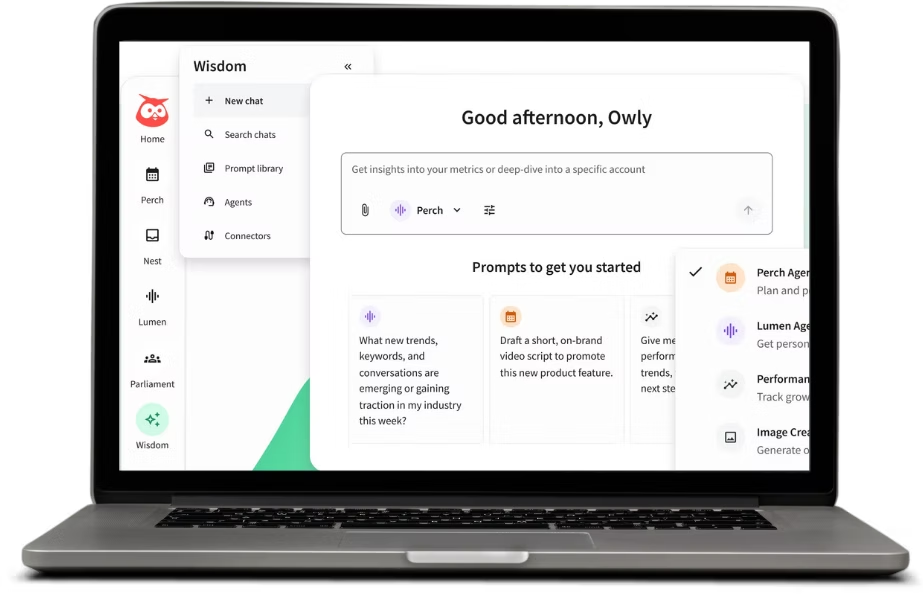
Hootsuite was considering what kinds of AI automations to build and how its AI experience should be structured, including whether to ship a single agent, several specialized agents, or a co-pilot. These decisions were being made while customer workflows were changing quickly, and there was little shared understanding of how users thought about AI, what they trusted it to do, or what the product’s AI terminology meant to them.
The research focused on one primary question:
Which tasks do users trust AI to run on its own versus assist with, and how should AI agents be named, organized, and supported to fit the way customers actually work?
The study also covered current AI adoption and confidence, the vocabulary users use for agents, co-pilots, models, tools, skills, and modes, appetite for a single AI-first surface, and how users understand AI consumption.
03. Approach
I partnered with Product and Design to turn open strategic questions into five research goals: current-state AI adoption, task fit and trust in automation, taxonomy perception, appetite for AI-first workflows, and the value of single versus multiple agents. Because the topic was new and fast-moving, I paired in-depth interviews with secondary sources so interview themes could be checked against what customers say and do at scale.
01
Align
Defined five research goals and a 60-minute interview guide with Product and Design, covering workflows, trust, terminology, and agent structure.
02
Interview
Spoke with 10 sales-enabled and self-serve customers across industries and Hootsuite products from July to August 2026.
03
Triangulate
Compared interview themes with customer feedback, industry reports, a competitor review, and product usage data.
04
Synthesize & Share
Consolidated findings into 9 recommendations and delivered a report to Product and Design.
Product names, internal usage data, customer identities, and roadmap details have been removed from this case study for portfolio use.
04. Key Insights
Current state & usage
AI use was widespread, but confidence and depth were not.
Only 3 of 10 participants felt confident using AI
Drafting, summarizing, and ideation were the dominant uses
Tool choice driven by output quality and data security
Users left built-in AI for external tools when it underperformed
Integrate best-in-class models rather than compete on quality, and differentiate on grounded answers, citations, and data governance.
Mental models & taxonomy
“Co-pilot” read as a Microsoft product, and “agent” meant different things to different people.
8 of 10 associated “co-pilot” with Microsoft Copilot
2 of 10 did not know what “models,” “tools,” or “skills” meant
Agents fit three roles: thinking partner, task executor, proactive assistant
Preferences split between one multi-purpose agent (6) and task-focused agents (5)
Rename the taxonomy so labels read as capabilities, and design agents around the role users expect.
“It’s not about trusting AI… it’s about trusting the people using it.”Enterprise participant
Trust & autonomy
Users would hand off low-stakes, reversible work, but kept judgment human-led.
All 10 participants saw themselves as responsible for catching AI errors
Citations, sources, dates, and reasoning expected before trusting output
Shaky answers cross-checked across tools or re-prompted
Autonomy tied to stakes and whether output is customer-facing
Offer per-task autonomy (suggest, act with approval, act and notify), default to approval, and always provide an easy undo.
Automate
Repeatable, low-stakes, reversible
Report and analytics pulls
Scheduling and reposting
FAQ, DM, and comment routing
Drafting and summarizing for review
Admin, calendar, and task breakdown
Data cleanup and QA
Keep human-led
Judgment, facts, money, relationships
Publishing public content
Creative and visual work
Final brand voice and tone
Facts, names, numbers, and data
Financial decisions and approvals
Sensitive communications
Tasks participants would hand to AI compared with tasks they would always review. All 10 participants placed high stakes on the human-led tasks.Consolidation & memory
Users wanted one AI surface that remembered them, gated by security and compliance.
Appetite to reduce tool-switching with a single AI surface
Over half cited security and compliance as the main barrier
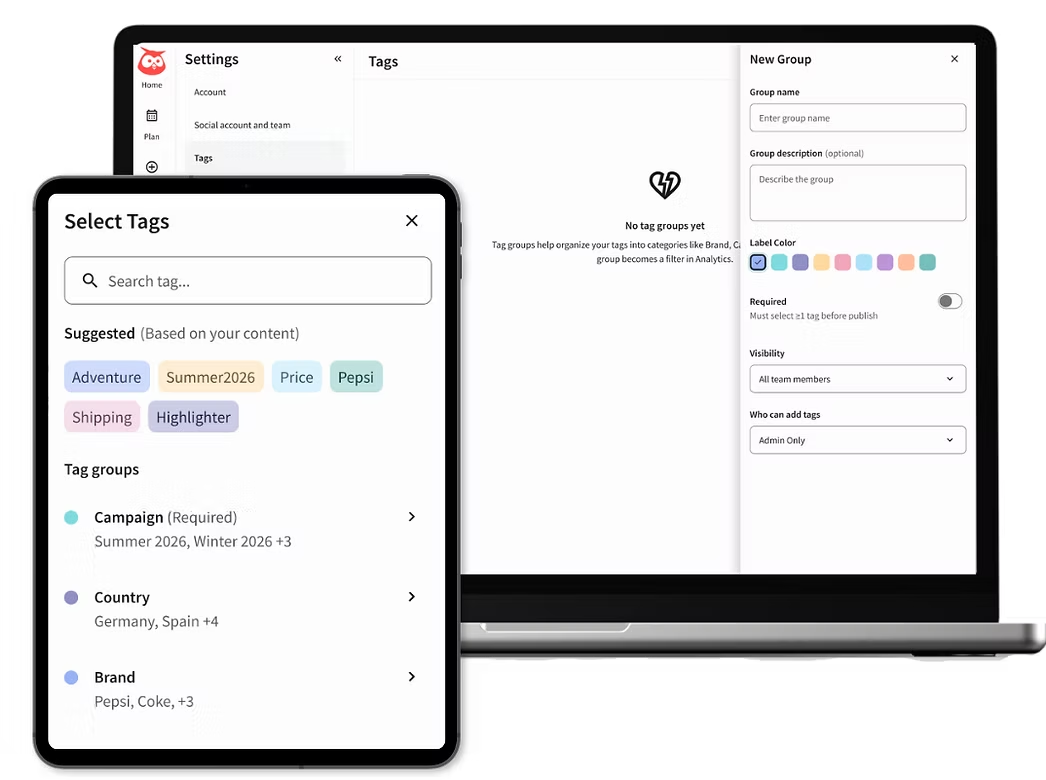
Expected brand voice, guidelines, and past decisions to carry across steps and products
Desktop and connector concepts resonated most with SMB and mid-market
Prioritize memory that learns from corrections and give enterprises a security-first story: closed models, no data training, and admin controls.
Escalating usage
Fear of runaway costs and a blank prompt box held novice users back.
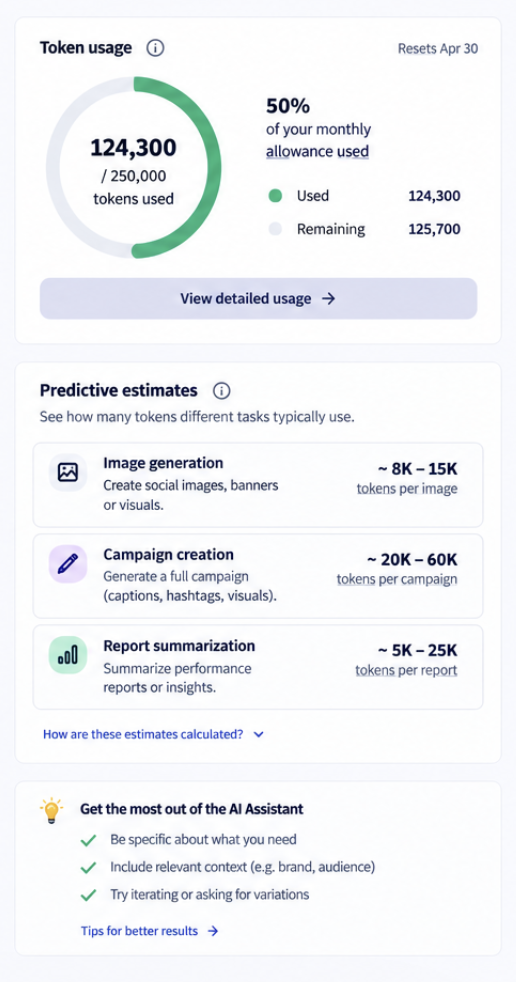
9 of 10 participants had limited or partial knowledge of AI consumption
Requests for a live meter, per-task usage, and predictive estimates
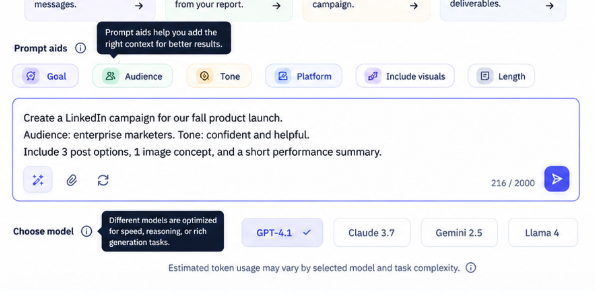
Novice users could not see what AI was capable of
Make consumption transparent and add prompt aids that show users what is possible.
Consumption meter & estimates
Prompt aids
Illustrative concepts generated from customer feedback to explore how consumption transparency and prompt aids could support novice users.
05. Impact
The report turned a broad set of open questions into 9 recommendations, each with an owner and impact rating and mapped to the product strategy pillars. Six were rated high impact, including per-task autonomy controls, trust signals such as citations and reasoning, governance controls for admins, and memory that learns from corrections. The research gave Product and Design a shared vocabulary, an evidence-backed view of where users will and will not delegate to AI, and a clearer basis for deciding when to ship an agent versus a co-pilot.
9
Prioritized recommendations
6
Rated high impact
2
Teams owning actions (Product, Revenue Enablement)